GAR 1110 Policy and Regulation Development
| Section: 1000 General Administration |
Sub Section: 1100 College Operations
|
| Title: GAR 1110 Policy and Regulation Development |
Primary Policy: BP 0510 Policy Development, Adoption, and Review
|
Associated Policy: GAP 1140 Institutional Effectiveness
|
Associated Regulation: GAR 1140 Institutional Effectiveness
|
References: NA
|
Supersedes: NA
|
| Responsible Administrator: College President; Chief Institutional Effectiveness Officer |
Initial Approval: 03-25-2015
|
Last Revision: 02-25-2026 |
Three Rivers College is committed to clearly articulating and publicly posting policies and regulations that support the advancement of the College Mission. The process of developing, reviewing, approving, and revising College policies and regulations is overseen by the Office of Institutional Effectiveness at the direction of the College President. The Board of Trustees, in consultation with the College President, approves and adopts policies that serve as the general principles for operations. The College President facilitates the process of creating new and revising existing policy and regulations through the Office of Institutional Effectiveness. The College Cabinet is responsible for ensuring that the perspectives of the College's various constituencies are represented in policy and that operations are clearly articulated through regulations. In this capacity, the College Cabinet serves as advisors to the President.
Roles, Responsibilities, and Definitions
Policy - Broad statements that determine a course of action. A policy describes the rationale for the purpose of the action. A policy may provide the foundation for how the Board of Trustees and the College operate.
Regulation - Provide detailed direction and guidance that initiates policy into practice. A regulation shall have an associated policy. A regulation may describe how, by whom, where, and when things are done. Specific language may include guidance as to the steps in completing or initiating a college process.
Board of Trustees – Approve and adopt appropriate policies as part of College governance structure.
College President – Develop policies for submission to the Board of Trustees for approval; Ensure the implementation of policies approved by the Board of Trustees; Develop and ensure implementation of regulations in support of College policies.
College Cabinet – Each member of the College Cabinet serves as a representative of a particular group at the College and/or serves as the leader of a significant function of the College. As a representative of a particular group of college employees, the cabinet member is responsible for communicating with members of the group to gather their input regarding college operations and to inform them of decisions made. Members of the College Cabinet are responsible for the creation and review of College policy and regulation, subject to guidance from the Chief Institutional Effectiveness Officer.
When listed as the administrator responsible for a policy or regulation, the Cabinet Member is responsible for ensuring that the policy or regulation is current, properly implemented, and administered by the institution. The Cabinet Member is further responsible for communicating all changes and alterations, and training required to properly implement the policy and/or regulation.
Office of Institutional Effectiveness – The Chief Institutional Effectiveness Officer oversees of the policy and regulation development process, under the direction of the College President.
While it is the responsibility of each Cabinet Member to maintain accuracy, current status, ongoing review, and the creation of new policies and regulations for their area of supervision, the Office of Institutional Effectiveness shall ensure the consistency of all policies and regulations and administers the process of policy and regulation development and revision. This process is facilitated by the Chief Institutional Effectiveness Officer in collaboration with the responsible administrator(s) and other members of the College Cabinet as necessary.
Initiation of New or Revision of Existing Policy or Regulation
New policies and regulations and the revision to existing policies and regulations are normally initiated by the responsible Cabinet member by contacting the Office of Institutional Effectiveness.
The Office of Institutional Effectiveness will then provide guidance and direction in the creation or revision of policy and/or regulation. When a draft is ready for review, the Office of Institutional Effectiveness will submit the draft of the new or revised policy or regulation to the College President for consideration and then forward to the College Cabinet for further review. If the College policy or regulation requires faculty approval, the Chief Academic Officer will advance a draft of the document to the appropriate governance groups and to the faculty at large for consideration. Once approved by faculty, it is resubmitted to the Office of Institutional Effectiveness for continued processing. The Office of the President facilitates the process for the Board of Trustees review and approval, as appropriate.
Following approval by the Board of Trustees, the Office of Institutional Effectiveness will initiate placing the protected document on the College website and ensure that the official copy is retained. The Office of Institutional Effectiveness will distribute notification of policy to the College community. The fully approved and adopted policy or regulation is then assigned to the responsible office(s); the respective supervisor(s) of said office(s) will have full responsibility for implementing the policy or regulation and training the College community as necessary.
Outline of Process:
- Cabinet Member contacts the Office of Institutional Effectiveness to initiate the development or review process.
- Office of Institutional Effectiveness seeks approval of the College President to begin the process.
- A draft is developed by the responsible administrator with consultation and guidance of the Office of Institutional Effectiveness.
- Once prepared for review, the Office of Institutional Effectiveness sends a draft electronically to all Cabinet Members for review. If needed, the Chief Institutional Effectiveness Officer shall revise the draft and resubmit it to the Cabinet for additional review. This step may be repeated until such time as the Cabinet recommends the document to move forward to the next level in the approval process, as appropriate.
- If the College President determines legal counsel is needed, the President will initiate the legal review process by forwarding a copy of the draft to legal counsel for review.
- Any changes to the document made through legal counsel are facilitated through the President to the Office of Institutional Effectiveness, and the revised document shall be shared with the College Cabinet for additional review.
- Policy and regulation documents that require faculty approval shall move through the faculty development and review process by the Chief Academic Officer. The Chief Academic Officer shall submit any changes to the document made through legal counsel to the Faculty Executive Committee for review.
- The Chief Academic Officer shall seek approval from the faculty-at-large as necessary.
- The President sends the final draft document for the Board of Trustees to review prior to the next monthly board meeting.
- The final draft document is presented as appropriate to the Board of Trustees during their regular monthly meeting.
- Any action taken during the Board Meeting is recorded by the Executive Assistant to the President. The recorded action regarding said document is communicated and the final, approved document and the modifiable document is maintained by the Office of Institutional Effectiveness.
- The Office of Institutional Effectiveness ensures that newly approved documents are protected and posted to the College website and notifies the College community as appropriate.
- Once notified of full Board approval or adoption, the responsible administrator shall initiate the appropriate implementation and training processes.
- Each responsible administrator oversees the implementation and maintains the accuracy, status, and integrity of all College policies and regulations under their supervision.
DOCUMENT HISTORY:
| 03-25-2015: |
|
Initial approval of regulation GAR 1001 Policy and Regulation Development |
09-16-2015:
|
|
Revision of position title Dean of Institutional Effectiveness to Chief Institutional Effectiveness Officer; Dean of Student Services to Chief Student Services Officer; and Vice President for Learning as Chief Academic Officer. |
| 12-09-2015: |
|
Minor edits and added the Chief Institutional Effectiveness Officer as the second responsible administrator. |
| 01-13-2016: |
|
Minor revision to GAR 1001 Policy and Regulation Development. GAR 1001 Policy and Regulation Development was revised to GAR 1110 Policy and Regulation Development due to addition of sub section number 1100 college operations to properly align section and subsection numbering system. |
| 09-21-2016: |
|
The College Board of Trustees approved the name change of the college from Three Rivers Community College to Three Rivers College. |
| 05-25-2017: |
|
Minor language edits and clarification of process. |
| 08-22-2018: |
|
Clarification of process to seek faculty approval for policy and regulation documents within section 6000 Instruction, and those with implications for students. |
| 02-25-2026: |
|
Clarification of steps and responsible roles within the process and elimination of unnecessary language and detail not strictly pertaining to the regulation. |
GAR 1120 College Reorganization
Section: 1000 General Administration
|
Sub Section: 1100 College Operations
|
Title: GAR 1120 College Reorganization
|
| Primary Policy: BP 0340 Code of Ethics |
References: NA
|
Supersedes: NA
|
Responsible Administrator: College President
|
Initial Approval: 07-27-2011
|
Last Revision: 09-21-2016
|
Three Rivers College reserves the right to administratively reorganize the functional operations of the college in times of business and/or financial necessity and/or when the administration determines that efficiencies can be realized by reorganization. The college must determine the priority for retaining academic and non-academic programs and services provided for the citizens of its voluntary service area in Southeast Missouri. College reorganization, the number and type of positions, the number of personnel, and the extent of funding commitments for the continuance of such programs and services are at the discretion of the college president to be recommended for final approval by the board of trustees.
The college continuously assesses the effectiveness and efficiency of its programs and services. Specifically, the college analyzes its strengths and weaknesses; organizational structure, operations and personnel; and focuses on functional areas for more efficiency. In the event of an administrative reorganization, the college shall scrutinize every functional area, position, and job responsibility to ensure that all departments are working as efficiently and effectively as possible. Reorganization may cause the college to outsource services, eliminate or merge positions, add positions, add duties to existing positions and to realign functional areas to better serve our students.
The office of human resources will make an earnest effort to assist regular exempt and non-exempt classified employees who are being displaced. Efforts may include assistance in locating other comparable positions within the college community, if available; may provide resume’ referral services; and may provide referrals to career counselors on a case-by-case basis.
DOCUMENT HISTORY:
| 07-27-2011: |
Initial approval of regulation GAR 1010 College Reorganization.
|
01-13-2016:
|
Minor revision to GAR 1010 College Reorganization. GAR 1010 College Reorganization revised to GAR 1120 College Reorganization due to the addition of sub section number 1100 College Operations to properly align section and subsection numbering system.
|
09-21-2016:
|
The College Board of Trustees approved the name change of the college from Three Rivers Community College to Three Rivers College.
|
GAR 1140 Institutional Effectiveness
Section: 1000 General Administration
|
Sub Section: 1100 College Operations
|
Title: GAR 1140 Institutional Effectiveness
|
Primary Policy: GAP 1140 Institutional Effectiveness
|
Associated Regulation: GAR 1110 Policy and Regulation Development; IR 6730 Faculty Bylaws
|
References: The Higher Learning Commission (HLC) Criterion Three: Teaching and Learning for Student Success; HLC Criterion Four: Sustainability: Institutional Effectiveness, Resources and Planning
|
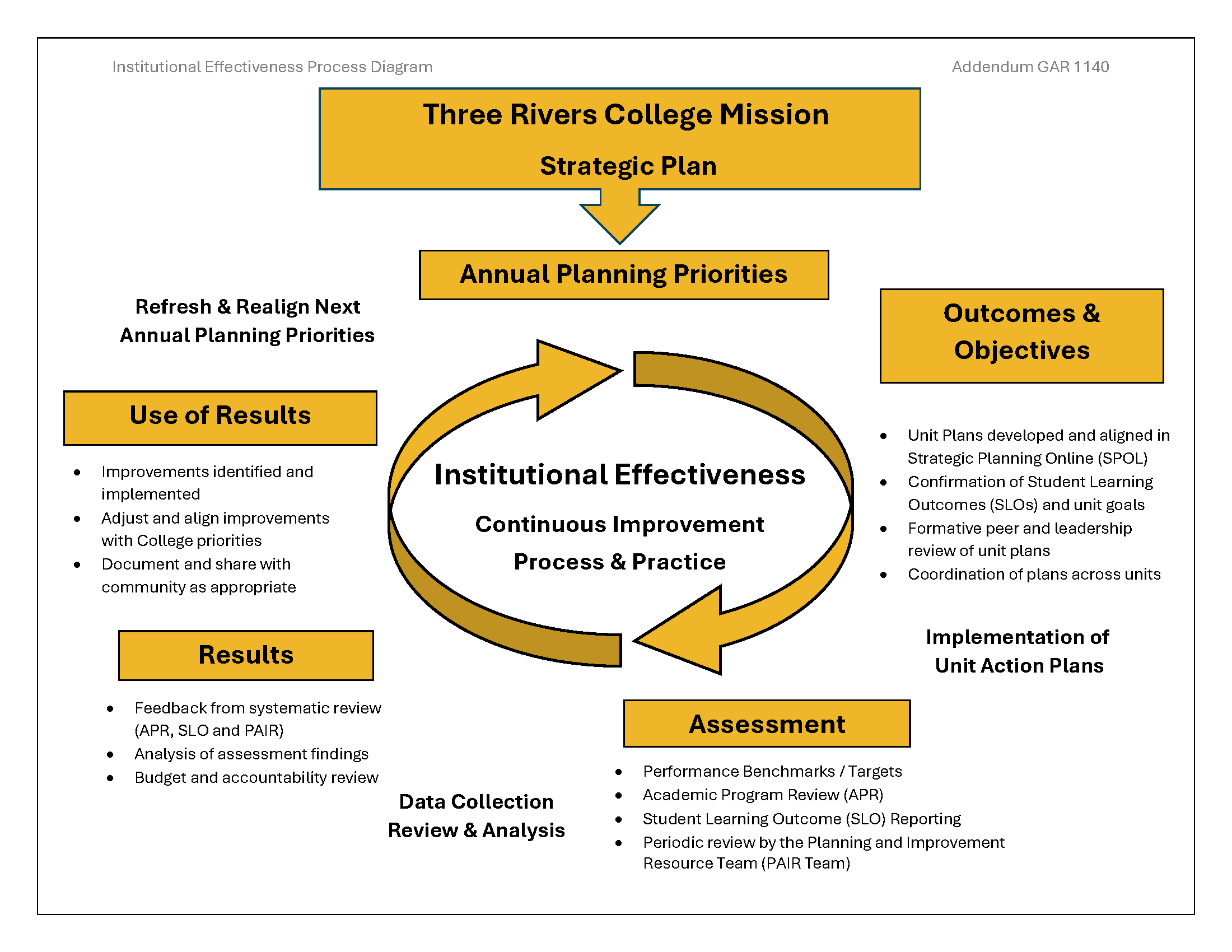
Addendum: “Institutional Effectiveness Process Diagram”
|
Supersedes: NA
|
Responsible Administrator: Chief Institutional Effectiveness Officer; College President
|
Initial Approval: 07-20-2016
|
Last Revision: 03-18-2026 |
Institutional Effectiveness is the College process that demonstrates achievement of the institutional mission through continual review of the Strategic Plan and its associated goals. Three Rivers College is committed to institution-wide, systematic, and data-informed continuous improvement through assessment of quality and effectiveness within all academic and administrative units, as guided by the College’s Mission and Strategic Plan.
Requirements
Three Rivers College engages in institutional effectiveness processes to determine the extent to which the College is operating within its mission and is meeting the goals and objectives set forth in its strategic plan. The assessment process ensures the College’s ability to demonstrate best practices in higher education and meet the institutional effectiveness standards set forth by the regional accreditor, the Higher Learning Commission (HLC), programmatic accreditors, and the standards set by the College.
The Higher Learning Commission (HLC) Criterion Four: Sustainability: Institutional Effectiveness, Resources and Planning states, “The institution’s resources, structures, policies, procedures and planning enable it to fulfill its mission, improve the quality of its educational programs, and respond to future challenges and opportunities.” To systematically demonstrate our ability to satisfy this criterion and to facilitate the processes to ensure alignment of the College’s annual planning priorities to the strategic plan and institutional mission, an integrated planning, budget development, and assessment software platform has been adopted.
Planning and Assessment Process
Planning and assessment are conducted by each academic and administrative unit on an annual and ongoing basis. The College planning and budget development cycle begins in January with an annual planning meeting. The planning year aligns with the annual fiscal calendar commencing on the first of July. Through the exercise of integrated planning, budget development, and assessment, the documentation of progress made toward specifically articulated goals, objectives, and outcomes is ensured. Data, analysis, benchmarks, institutional targets, and objective results are appropriately associated with action plans for units, departments, and academic programs. Assessment results from planning unit progress reports, surveys, focus group interviews, Academic Program Review (APR), and the results from Student Learning Outcome assessment (SLO Reports) are used to inform programmatic and administrative decisions, strategic planning initiatives, and resource allocations. See Addendum: Institutional Effectiveness Process Diagram.
Duties and Responsibilities
The Office of Institutional Effectiveness provides leadership in the design and implementation of processes outlined herein and provides training and support to unit managers in their continuous improvement efforts. The College Cabinet, the standing committees of the faculty and staff, and the Board of Trustees are fully engaged and invested in institutional effectiveness processes.
Unit managers of academic and administrative units are responsible for ensuring the systematic continuous improvement process is properly aligned with the strategic plan, executed and documented during each cycle, and that specific data-based action is taken to improve.
Definitions
Academic Program Review (APR): a process to examine the effectiveness of an academic program and inform the continuous improvement efforts of the College. The APR process is applied to career and technical degree programs and designated academic initiatives. The process provides feedback (a) to the academic unit primarily responsible for the program, (b) to the appropriate academic administrators, (c) to external advisory boards, (d) and to the faculty body of the College. The purpose and process of Academic Program Review is directly aligned to HLC Criterion Three, Teaching and Learning for Student Success.
Assessment: the process of determining whether the College is meeting the goals established in unit and department operational plans. Assessment is conducted by each academic and administrative unit on an annual basis and follows the fiscal calendar. The continuous assessment of the quality of instructional and service programs at Three Rivers College is a necessary component of institutional effectiveness. The results of assessment are used to inform planning and budget development.
Annual Planning Priorities: established annually from the strategic plan by the College Cabinet. The Annual Planning Priorities provide specific focus for the annual continuous improvement efforts of the College.
Institutional Effectiveness: is a process that demonstrates achievement of the institutional mission through continual review of the institution’s strategic plan and its related goals and outcomes. This process is acknowledged and accepted in higher education as evidenced by established terminology in regional accreditation criteria and ensured through coordinated planning and assessment processes that intentionally foster a culture of decision making based on data and assessment rooted in the vision, core values, mission, and goals of the College.
Planning and Improvement Resource Team (PAIR Team): A cabinet-appointed body of faculty, staff, and administrators who are knowledgeable in strategic planning, budgeting, assessment methodology, compliance, and accreditation assumed practices. The purpose of the body is to individually support and mentor Planning Unit Managers through regular review and formative feedback and collectively consider challenges related to planning and assessment across all functional areas of the College. The body may make recommendations to the Cabinet to address challenges identified. Recommendations may include changes in the College’s strategic planning process, targeted professional development, and the adoption of identified best practices. The Planning and Improvement Resource Team will advocate for quality enhancement and serve as champions for a culture of assessment and continuous improvement.
Strategic Planning: the organizational process by which the achievement of the institutional mission is recognized and measured. Through this process, the long-term goals of the institution are defined, priorities are established, actionable objectives are developed, resources are allocated, performance is tracked, and data is used to refine priorities and strategies over time. Three Rivers College demonstrates its commitment to institutional effectiveness by developing and maintaining institutional planning and assessment processes that result in continuous improvement. Through a shared governance model, college planning and assessment include broad representation across the college community in establishing institutional priorities, guiding decision-making, and allocating resources to ensure that the College is meeting the needs of its stakeholders in accord with its mission.
Student Learning Improvement Committee (SLIC): The Student Learning Improvement Committee provides review and feedback on the student learning outcomes process under the leadership of the Chief Academic Officer in concert with the Office of Institutional Effectiveness.
[SLIC Duties] The committee shall coordinate and promote student learning outcomes assessment for the purpose of improving learning of specific programs, College-wide outcomes, and the curriculum as a whole to ensure that these activities are used to improve learning and to provide feedback to faculty on ways to improve student learning and increase student success. The committee serves as a peer panel to review and provide feedback on assessment results and learning improvement initiatives.
Student Learning Outcomes Reports (SLO Reports): an examination of student learning within a specific academic program by measuring student achievement relative to statements of what students should know and be able to do by the end of a learning experience (generally a career or technical program completion). The reporting and associated feedback process is designed to assist program managers and faculty in identifying and prioritizing opportunities to improve learning, and to examine the effectiveness of implemented improvements over time.
DOCUMENT HISTORY:
| 07-20-2016: |
Initial approval of regulation GAR 1140 Institutional Effectiveness.
|
09-21-2016:
|
The College Board of Trustees approved the name change of the college from Three Rivers Community College to Three Rivers College.
|
05-24-2017:
|
Minor revisions for clarification.
|
03-18-2026:
|
Updated references, aligned with updated processes and faculty bylaws and removed unnecessary description.
|
GAR 1140 Addendum
GAR 1160 Institutional Review Board
| Section: 1000 General Administration |
| Sub Section: 1100 College Operations |
| Title: GAR 1160 Institutional Review Board |
| Primary Policy: GAP 1160 Institutional Review Board |
| References: Code of Federal Regulations; Title 45, part 46. |
| Addendum: “Application Form for Consideration of Initial Research Proposal” |
| Supersedes: NA |
| Responsible Administrator: Chief Institutional Effectiveness Officer |
| Initial Approval: 06-21-2017 |
Last Revision: |
Three Rivers College has established an Institutional Review Board (IRB) Regulation to facilitate the review of requests for research studies involving human subjects (students, faculty, and/or staff) from the college. The purpose of this regulation is to provide a comprehensive standard framework for the protection of human subjects of research that may be conducted by students, staff, faculty, and on a limited basis may allow visiting researchers. The intent is to ensure that investigators do not unduly put at risk or harm humans who are the subjects of their research, and that the subjects of such research are aware of their rights as defined herein. The college reserves the right to reject an IRB application without cause.
All persons who wish to conduct research involving human subjects at the college must follow the college process and receive authorization from the Chief Institutional Effectiveness Officer prior to conducing their research. Authorization from the Chief Institutional Effectiveness Officer and in most cases IRB approval shall precede commencement of any work involving human subjects from Three Rivers College. The college IRB process is established to determine and ensure that:
- The welfare and rights of human subjects are adequately protected and informed consent given, if necessary;
- Human subjects are not placed at unreasonable physical, mental, or emotional risk as a result of the research;
- The research outcomes are of significance to the interests of the college;
- The necessity and importance of the research outweighs the risks to the subjects; and
- The researcher(s) is/are qualified to conduct research involving human subjects.
Three Rivers College faculty and staff as well as any other persons desiring to conduct research using college faculty, staff or students as research subjects shall abide by this regulation. This regulation is intended for use by investigators, researchers, and members of college administration or others involved with research involving human subjects at the college. To be considered, the purpose and scope of the research must be deemed to be beneficial to Three Rivers College. If it is determined that an Institutional Review Board (IRB) must be convened, the Chief Institutional Effectiveness Officer shall convene an ad hoc committee. Upon review of an application in which the applicant is a graduate student of a college or university where an IRB was approved for the purposes of the same said study, the Chief Institutional Effectiveness Officer may accept the IRB from that college if the purpose and scope of the research is deemed to be beneficial to Three Rivers College.
An Institutional Review Board (IRB) is a committee established to review and approve research involving human subjects. The IRB consists of at least five ad hoc members from the college. The members will have varying backgrounds to promote complete and adequate review of research activities commonly conducted by the institution. The purpose of the IRB is to ensure that all human subject research be conducted in accordance with all federal, institutional, and ethical guidelines.
Human subjects’ research is:
- a systematic investigation that is time limited;
- designed to contribute to general knowledge of the college;
- often not published outside the college;
- may use approved classroom surveys for internal use only;
- data-gathering for the exclusive purpose of improving the college.
The approval process begins by submitting the Application Form for Consideration of Initial Research Proposal to the Office of Institutional Effectiveness. If the research project is approved to proceed to the next level an IRB Packet must be submitted to the Office of Institutional Effectiveness.
If the investigator has received prior IRB approval from their graduate institution, the Three Rivers College IRB could be waved as long as the research project meets the institutional criteria and the IRB is within one-year of approval. In this case, the Three Rivers College IRB Application must include the complete research proposal documents from the investigators graduate school and the research focus and timeframe must be the same.
The investigator(s) shall contact the Office of Institutional Effectiveness for initial screening and proposal review by the Chief Institutional Effectiveness Officer.
- The investigator must complete & submit the initial application for consideration of research to the Office of Institutional Effectiveness.
- The Chief Institutional Effectiveness Officer has the authority to determine if an IRB request will be considered. This decision is based on college priorities as well as project data requirements for the IRB and if the proposal for research is deemed to be beneficial to Three Rivers College.
- The Chief Institutional Effectiveness Officer has the authority to approve the request.
- If the Chief Institutional Effectiveness Officer determines the IRB must review the proposal, an ad hoc committee will be convened to approve, deny, or seek clarification.
- IRB evaluates risks, recruitment, informed consent, data security, privacy, and confidentiality provisions.
- Decisions shall be made within 4 weeks of application submission.
- An IRB decision letter is provided to the investigator by the Chief Institutional Effectiveness Officer.
- If approved, the investigator must communicate ongoing progress to the Office of Institutional Effectiveness. This includes submitting a detailed research plan and, as the research progresses must report on any changes in purpose, scope, or timeline to the original research plan submission.
- Investigator shall submit any data gathered and the final research summary report of findings to the Chief Institutional Effectiveness Officer.
Three Rivers College has established a process for IRB for the identification and minimizing of any potential risks to students. Just about all research involves some risk. It may be physical, social, economic, or psychological in nature. In approving the project, the Institutional Review Board (IRB) will make a determination on the risks involved. The IRB will also assess if the risks have been minimized as much as possible without compromising the validity of the research. The IRB will also analyze the benefits of the research to the college, whether the risk is reasonable in relation to its benefits, whether the selection of the subjects is equitable, if informed consent will be sought, and if there are adequate provisions in place to protect the confidentiality of the subjects.
To ensure students are protected, any research that takes place under the College’s auspices must have respect for persons as autonomous agents. Therefore, all subjects must be informed about what participation in the project entails. This requires that the individual subjects must read and sign an informed consent form prior to participating in the study. It is important that the researchers ensure that the potential participants understand what is required of them as research subjects. Federal law requires that individuals 18 years or older are capable of giving informed consent.
Subjects under 18 years of age may participate in the research project only with the signature of the parent or legal guardian in addition to their own signature. This requirement also applies to the filling out of anonymous questionnaires. If children are selected as participants the research must be explained to the minor child by their parent or their guardian in language that they can understand.
There may be times when it is necessary to withhold some pertinent information from the subjects when disclosure of this information would likely impair the validity of the study. In such cases, subjects should be told that they are being invited to participate in research in which some features will not be disclosed until their participation has ended or the research has concluded, whichever is more feasible. However, researchers are not to deceive subjects in anyway regarding the research project as if this is disclosed, would affect their decision to participate.
Three Rivers College protects the confidentiality and anonymity of students. Therefore, it is important that all human subjects involved in research maintain their confidentiality. This is especially important if the research involves asking the participants questions regarding their personal life or other information that the individual does not want to be made public.
The Office of Institutional Effectiveness shall review all instruments used in the research and shall adhere to a regulation of total anonymity. Therefore, the researcher will not have access to the individual’s name or other identifiable information, the researcher must tell the individual who will have access to the data, the purpose of the data and how the information thus gathered shall remain confidential.
The Office of Institutional Effectiveness provides oversight for the Institutional Review Board (IRB) process and will provide for the maintenance of records relating to a specific research activity for at least three years after termination of the last IRB. IRB records will be available for inspection and copying by authorized representatives only; and at reasonable times and in a reasonable manner.
DOCUMENT HISTORY:
| 06-21-2017: |
Initial approval of regulation GAR 1160 Institutional Review Board. |